
WELCOME BONUS 300%
UP TO €2000 + 100
FREE SPINS
UP TO €2000 + 100
FREE SPINS
Home → Blackjack
Blackjack at Bellagio Casino: Variants, Rules and Payouts
Soft 17: Does the Dealer Hit or Stand?
Blackjack 6 decks, S17, DAS, DOA, 3:2 payout, basic strategy reaches an RTP of 99.54% and a house edge of 0.46%. The house edge is the average share of each stake that the casino keeps over the long run. On €100 of stakes, that edge costs €0.46 on average when the dealer stands on soft 17 and basic strategy is followed.
Dealer hitting soft 17 lowers the RTP by 0.22 percentage points, which is the H17 rule modifier in the Blackjack Split / double / H17 table. A 3:2 blackjack pays €150 on a €100 stake, while 6:5 only pays €120, and the H17 change is smaller than that payout gap. Doubling after a split improves the return by about 0.14 percentage points.
Resplitting aces improves the return by 0.08 percentage points, and moving from 8 decks to 6 decks is worth about 0.02 percentage points. Blackjack Liberal Vegas Strip combines S17 with DAS, resplit and late surrender for an RTP of 99.72% and a house edge of 0.28%. That rule set keeps €0.28 per €100 staked instead of €0.46.
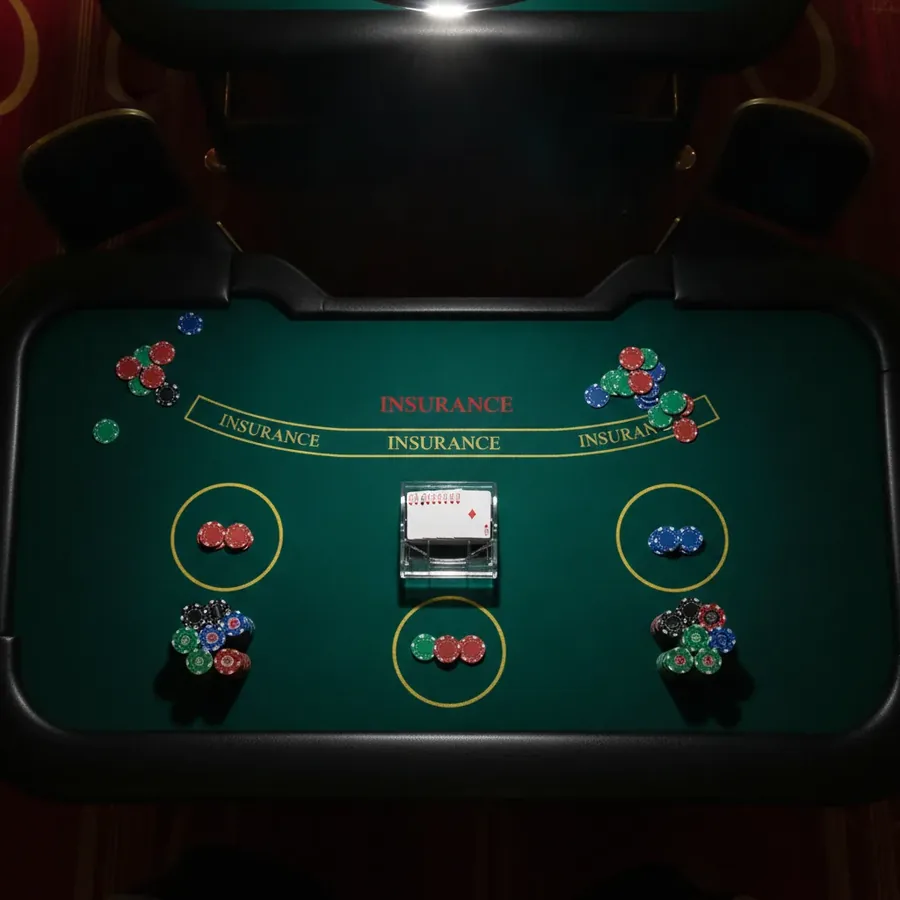
Insurance vs Even Money When You Hold Blackjack
Blackjack Insurance on 6 to 8 decks carries an RTP of 92.53% and a house edge of 7.47% on a side bet of up to 50% of the main bet when the dealer shows an ace. A side bet is a separate wager placed alongside the main hand. On a €10 insurance bet, the long-run cost is €0.75 on average at that 7.47% edge.
With a single deck the insurance edge is about 5.88%, which is lower than the 7.47% on 6 to 8 decks. Insurance pays 2:1, so a €10 side bet returns €20 when it wins. Basic strategy always declines insurance, except for card counters at a true count of +3 or higher.
A player holding a blackjack faces a choice between even money and the 2:1 insurance payout. A 3:2 blackjack on a €100 stake pays €150, while 6:5 pays only €120, so the payout format changes the value of the hand. The insurance side bet lowers the return in the long run at the 92.53% RTP.
Early Surrender Is Gone From Many Tables
Late surrender improves the return by about 0.08 percentage points, and the player gives up the hand after the dealer has checked for blackjack and loses half the stake. On a €100 stake, surrender returns €50. Early surrender is worth much more, up to 0.6 percentage points, but it is extremely rare.
Blackjack Liberal Vegas Strip includes late surrender together with S17, DAS and resplit, producing an RTP of 99.72% and a house edge of 0.28%. On €100 staked, that edge costs €0.28 on average. The surrender rule modifier alone accounts for 0.08 of those percentage points.
Blackjack 6 decks, S17, DAS, DOA, 3:2 payout, basic strategy has an RTP of 99.54% and a house edge of 0.46% without surrender. The 0.08 percentage point gain from late surrender is smaller than the 0.22 percentage point loss from dealer hitting soft 17. On €100 staked, the difference between 0.46% and 0.28% is €0.18.
Blackjack Party Has Two Hosts
Blackjack Party from Evolution is a live blackjack table with a bet range of 1.00 to 1,000 EUR and a party atmosphere with two hosts. The lower end of the range is 1.00 EUR and the upper end is 1,000 EUR. A player staking the 1.00 EUR minimum keeps the same 3:2 blackjack payout ratio as at the top of the range.
Quantum Blackjack Plus Live from Playtech offers a bet range of 1 to 5,000 EUR and an RTP of 99.57% with optimal strategy. The house edge on that figure is 0.43 percentage points, since 100% minus 99.57% equals 0.43%. On €100 staked, that edge costs €0.43 on average.
Quantum Blackjack Plus Live applies Quantum multipliers up to 1,000x on 3-card combinations worth 21 points. Both tables sit above the 99.54% RTP of the 6-deck S17 basic strategy game.
What the Peek Means When the Dealer Shows an Ace
When the dealer shows an ace, Blackjack Insurance allows a side bet of up to 50% of the main bet, and basic strategy always declines it except for card counters at a true count of +3 or higher. The insurance RTP is 92.53% on 6 to 8 decks, with a house edge of 7.47%. A €10 side bet costs €0.75 on average at that edge.
Insurance pays 2:1, so €10 returns €20 when the dealer holds a blackjack. The peek step happens before the player acts, which is why the insurance decision is offered at that moment.
Late surrender is only available after the dealer has checked for blackjack, and it returns 50% of the stake. On a €100 bet, surrender returns €50. Blackjack 6:5 instead of 3:2 adds 1.39 percentage points to the casino's edge, moving the RTP from 99.54% to 98.15%, which is a larger swing than any insurance decision on the same hand.
Blackjack variants at a glance
| Variant | Payout | House edge | Rule | RTP |
|---|---|---|---|---|
| Blackjack Insurance (6–8 decks) | Insurance 2:1 | 7.47% | Separate side bet of up to 50% of the main bet when the dealer shows an ace. Basic strategy ALWAYS declines it (except for card counters at a true count ≥ +3). With a single deck the edge is ≈ 5.88% | 92.53% |
| Blackjack 6:5 payout instead of 3:2 (6 decks) | Blackjack 6:5, win 1:1 | 1.85% | Replacing 3:2 with 6:5 adds exactly +1.39 percentage points to the casino's edge – more than any other rule change. On a €10 bet a blackjack pays €12 instead of €15. | 98.15% |
| Blackjack Single deck, classic rules, 3:2 | Blackjack 3:2, win 1:1 | 0.15% | Fewer decks = lower edge; one deck gives about −0.48 percentage points compared with 8 decks. Often offset by a 6:5 payout. | 99.85% |
| Blackjack Split / double / H17 – rule effects | Double – stake ×2 with one card; split – up to 4 hands; split aces usually get one card each. | H17 +0.22 percentage points; RSA −0.08 percentage points; DAS −0.14 percentage points | Dealer hitting soft 17 lowers RTP by 0.22 percentage points; resplitting aces improves it by 0.08 percentage points; doubling after a split improves it by about 0.14 percentage points; 6 decks instead of 8 – about 0.02 percentage points. | n/a (rule modifiers) |
| Blackjack Surrender (late surrender) – rule effect | 50% of the stake returned | −0.08 percentage points | The player gives up the hand after the dealer has checked for blackjack and loses half the stake. Improves RTP by about 0.08 percentage points. Early surrender is worth much more (up to −0.6 percentage points) but is extremely rare. | n/a (rule modifier) |
| Blackjack Liberal Vegas Strip (liberal rules, 3:2) | Blackjack 3:2, win 1:1 | 0.28% | The most player-friendly rule set: S17 + DAS + resplit + late surrender. Standard deviation 1.15 | 99.72% |
A Side Bet Every Round: The Budget Lasts 30 Rounds
Blackjack Insurance is a side bet of up to 50% of the main bet, taken when the dealer shows an ace, and it pays 2:1. On a €10 main bet the insurance stake reaches €5, so one round costs €15 instead of €10. A player who insures every qualifying round therefore turns a €450 bankroll into 30 rounds of €15 rather than 45 rounds of €10.
The insurance bet returns 92.53% RTP against 99.72% for Blackjack Liberal Vegas Strip, a gap of 7.19 percentage points. On €100 of insurance stakes the casino keeps €7.47 on average, while €100 on the liberal main game keeps €0.28. With a single deck the edge is about 5.88%, still far above the main bet.
Basic strategy always declines insurance, and only card counters at a true count of +3 or higher take it. A player who skips the side bet keeps the full €10 main stake in play and preserves the 99.72% return of the liberal rule set. The €5 saved each round is €150 across 30 rounds.
16 vs 10 played incorrectly: most common error
A hard 16 against a dealer 10 is the spot where hitting and standing are closest, and the rule set decides the outcome. Blackjack Liberal Vegas Strip carries a 0.28% house edge and includes late surrender, which lets the player give up the hand after the dealer checks for blackjack and lose half the stake. Surrender improves RTP by about 0.08 percentage points.
Blackjack 6 decks with S17, DAS and DOA shows a 0.46% house edge and no surrender, so the same 16 must be played by hitting. The 0.18 percentage point difference between 0.28% and 0.46% is the price of the weaker rule set. On €100 of stakes the liberal table costs €0.28 and the six-deck table €0.46.
Blackjack Single deck with classic rules and a 3:2 payout reaches 99.85% RTP and a 0.15% house edge, the lowest on offer. Fewer decks lower the edge by about 0.48 percentage points against eight decks. A surrender option at that table would push the return even higher, but early surrender is extremely rare.
Splitting Eights vs Standing on 16
A pair of eights is split because standing on a hard 16 loses to most dealer upcards, and the split turns one weak hand into two starting hands. Splitting is allowed up to 4 hands, and doubling after a split improves RTP by about 0.14 percentage points. Resplitting aces adds another 0.08 percentage points.
Doubling after a split lowers the house edge by 0.14 percentage points, which on €100 of stakes is €0.14 saved. Blackjack 6 decks with S17, DAS and DOA sits at 0.46% because of that rule, while removing DAS would raise the edge. The dealer hitting soft 17 adds 0.22 percentage points instead.
Blackjack Liberal Vegas Strip combines S17, DAS, resplit and late surrender for a 0.28% house edge and 99.72% RTP, the most player-friendly set in the comparison. Its standard deviation is 1.15. Split aces usually receive only one card each, so the resplit of aces and the DAS rule are not both available on every pair.
Which Rule Variants the Software Shows
Blackjack Liberal Vegas Strip carries a 99.72% RTP and a 0.28% house edge through S17, DAS, resplit and late surrender. Blackjack 6 decks with S17, DAS and DOA follows at 99.54% RTP and 0.46%, and Blackjack Single deck with classic rules and 3:2 leads at 99.85% RTP and a 0.15% house edge.
Blackjack Insurance runs at 92.53% RTP with a 7.47% house edge on the side bet, and a 6:5 payout version of the six-deck game drops to 98.15% RTP and a 1.85% house edge. On a €10 bet a blackjack pays €12 at 6:5 instead of €15 at 3:2, a difference of €3 per blackjack.
Calling Late Surrender Correctly in Three Steps
Late surrender is a rule modifier worth −0.08 percentage points of house edge, which means the return improves by about 0.08 percentage points when the option exists. The player gives up the hand after the dealer has checked for blackjack and loses half the stake, so a €10 bet returns €5. Early surrender is worth far more, up to −0.6 percentage points, but it is extremely rare.
The first step is to confirm the table actually offers late surrender, because the standard 6-deck game with S17, DAS, DOA and a 3:2 payout runs at a 0.46% house edge with no surrender at all. Adding late surrender moves that figure to roughly 0.38%. On 100 € of stakes the average cost falls from 0.46 € to about 0.38 €, a saving of 0.08 € per 100 € wagered.
The second step is timing: surrender is only available after the dealer has checked for blackjack, never before. The third step is accepting the half-stake loss rather than playing out a hand that basic strategy has already written off. Liberal Vegas Strip rules combine S17, DAS, resplit and late surrender for a 99.72% RTP and a 0.28% house edge, the most player-friendly set on this page.
Place Side Bets Before the Cards Are Dealt
Insurance is the classic side bet, a separate wager of up to 50% of the main bet placed when the dealer shows an ace, and it pays 2:1. Its RTP is 92.53% with a house edge of 7.47% across 6 to 8 decks, which is far worse than the 99.54% RTP of the underlying 6-deck game. With a single deck the insurance edge falls to roughly 5.88%.
Converting the edge: 100 € staked on insurance costs 7.47 € on average, against 0.46 € for the same 100 € on the main 6-deck bet, so the side wager is about sixteen times more expensive per euro. The 2:1 payout only looks generous because it lands rarely.
The timing rule matters because insurance must be placed before any further cards are dealt, at the moment the dealer's ace is exposed. Those multipliers sit on the main bet, not on insurance.
Continuous Shuffling Machines Reshuffle After Every Round
A continuous shuffling machine returns every played card to the shoe immediately, so the shoe is reshuffled after each round rather than at a cut card. Deck count drives the edge: one deck gives about −0.48 percentage points compared with 8 decks, and 6 decks instead of 8 is worth about 0.02 percentage points. Single deck, classic rules, runs at 99.85% RTP and a 0.15% house edge.
The 0.15% edge on single deck is often offset by a 6:5 payout instead of 3:2, and that single change adds exactly +1.39 percentage points to the casino's edge, taking the RTP down to 98.15% and the house edge up to 1.85%. On a €10 bet a blackjack pays €12 at 6:5 instead of €15 at 3:2, a difference of €3 on the same hand.
For the reader, a continuous shuffling machine removes the deck-depth advantage that single and double deck games offer, because the composition never depletes. A 6-deck shoe with S17, DAS, DOA and a 3:2 payout sits at 99.54% RTP and 0.46% house edge when basic strategy is followed, and that figure already assumes a fixed number of decks in play. The machine changes the pace, not the published edge.
Doubling After a Split: Which Tables Allow It
Doubling after a split is worth about −0.14 percentage points of house edge, meaning the return improves by roughly 0.14 percentage points where the rule is offered. Resplitting aces improves it by 0.08 percentage points, while the dealer hitting soft 17 lowers RTP by 0.22 percentage points. The 6-deck S17, DAS, DOA, 3:2 game with basic strategy reaches 99.54% RTP and a 0.46% house edge.
The arithmetic is visible on the rule list: start from a base and add −0.14 for DAS, add −0.08 for resplitting aces, add +0.22 for H17. A table with H17 and no DAS therefore carries a noticeably higher edge than the 0.46% benchmark, while a table with S17 plus DAS plus resplit plus late surrender reaches 99.72% RTP and 0.28%. A double doubles the stake and draws exactly one card; a split creates up to 4 hands, and split aces usually receive one card each.
Liberal Vegas Strip rules combine S17, DAS, resplit and late surrender, and their standard deviation of 1.15 shows how widely single sessions can swing around the 99.72% average. On 100 € of stakes at a 0.28% edge the expected cost is 0.28 €, against 0.46 € at the 6-deck benchmark, so choosing a DAS table saves about 0.18 € per 100 € wagered.
How many decks are in the shoe?
Deck count is the single most quoted parameter in blackjack, and the spread runs from one deck at 99.85% RTP and a 0.15% house edge to the 6-deck benchmark at 99.54% RTP and a 0.46% house edge. Moving from 8 decks to 6 decks is worth about 0.02 percentage points, a small but measurable gain. Fewer decks mean a lower edge because the composition of the remaining cards is easier to track.
The catch is that the 0.15% single-deck figure is often paired with a 6:5 payout, and 6:5 instead of 3:2 adds exactly +1.39 percentage points to the house edge, pushing the RTP down to 98.15% and the edge up to 1.85%. On a €10 stake that is a €12 payout instead of €15, so the headline deck count is worth less than the payout line printed next to it.
At the live tables the shoe is fixed by the studio: Blackjack Party from Evolution takes bets from 1.00 € to 1,000 €, Lightning Blackjack from Evolution takes 1 € to 2,500 € at a 99.56% RTP, and Quantum Blackjack Plus Live from Playtech takes 1 € to 5,000 € at 99.57%. Checking the deck count before sitting down costs nothing and sets the baseline for every later decision.
Contact
Live - online chat
Banking









Providers












Bellagio Casino 2026